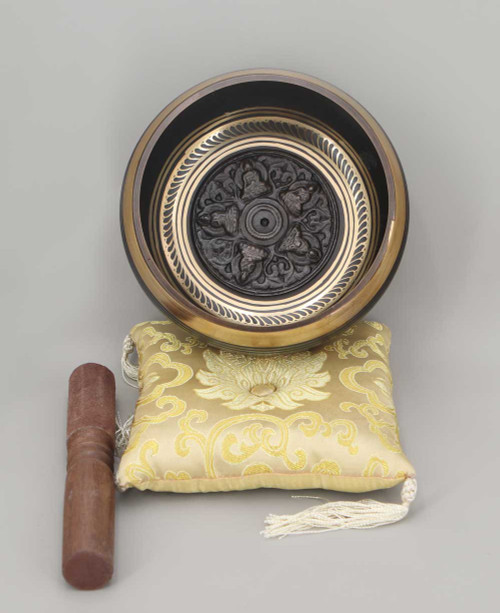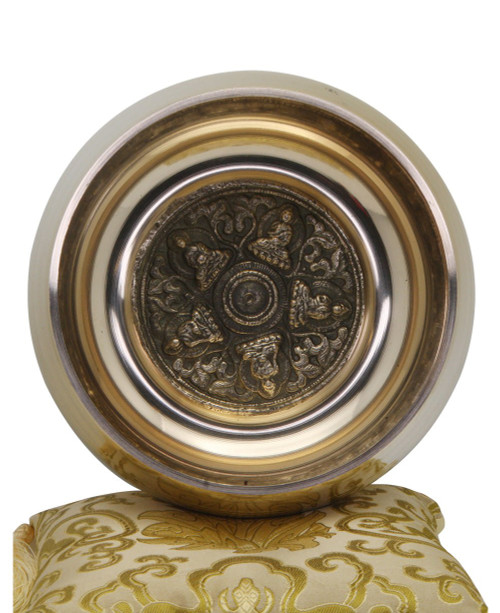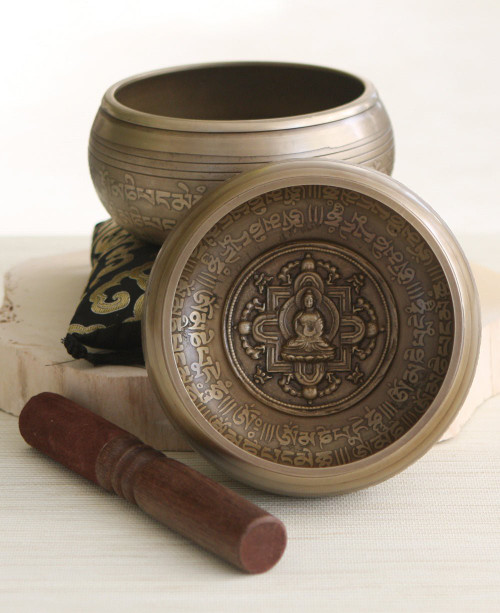


Singing bowls have long been used for mediation and inducing trances. Made of traditional metals, this singing bowl is etched with the mantra, Om Mani Padme Hum, on its outside and along its interior. Inside the bowl’s center is a beautifully embossed design of the five Dhyani Buddhas. The bowl comes with a striker mallet and a black silk cushion. To use, simply tap the side of the bowl with the wooden striker and proceed to run the striker around the edge. The bowl’s harmonious vibrations will help clear the mind and promote deep relaxation.
- Singing bowl with 5 Dhyani Buddhas
- Decorated with “Om Mani Padme Hum”
- Made of mixed metal
- Bowl is approximately 2.75 inches high
- Has a diameter of 5.5 inches at the widest point
- Weighs approximately 1.75 pounds
- Made in Nepal
Made by Tibetan artists in Nepal – variations in metal finish, size and weight may be present, enhancing individual character of each singing bowl. The bowl is made in traditional style and is mixture of copper, lead, tin and iron metals.
design: A hand-hammered singing bowl in warm mixed-metal tones, its outer wall banded with fine ridgework and its inner surface fully engraved with Tibetan script encircling a raised medallion of the five Dhyani Buddhas at the center.
size: Approximately 2.75 inches high with a 5.5-inch diameter at the widest point; weighs approximately 1.75 pounds.
material: Mixed metal (copper, lead, tin, and iron alloy)
features: Etched exterior and interior with the mantra Om Mani Padme Hum, embossed center medallion depicting the five Dhyani Buddhas, includes wooden striker mallet and black silk cushion, hand-finished by Tibetan artisans in Nepal
care: Wipe clean with a soft, dry cloth and store away from moisture to preserve the metal's natural patina.
disclaimer: Because each bowl is hand-formed by Tibetan artisans, slight variations in metal finish, size, and weight are natural and add to its individual character.
Meaning & Intention
At the center of this bowl sit the five Dhyani Buddhas, the celestial forms of Vairocana, Akshobhya, Ratnasambhava, Amitabha, and Amoghasiddhi, each governing a direction, an element, and a particular wisdom that counters a specific mental affliction. Together they form a complete map of enlightened awareness, reminding the practitioner that clarity is reached not by rejecting difficulty but by transforming it.
Encircling the bowl, inside and out, is the mantra Om Mani Padme Hum, one of the most widely chanted invocations in Tibetan Buddhism and closely associated with Avalokiteshvara, the bodhisattva of compassion. Each syllable is traditionally linked to a step on the path toward purifying body, speech, and mind, so the words act as a spoken companion to the bowl's sounded tone.
The singing bowl itself carries an older lineage as a tool for concentration, its rim tone said to still the chatter of the mind long enough for stillness to be felt rather than described. Paired with the mantra and the five Buddhas, this particular bowl functions as both instrument and teaching object, its sound and imagery reinforcing the same message of awakened presence.
Used at the start or close of a meditation session, or simply sounded during a quiet moment at a desk or altar, this bowl offers a way to mark a transition, from the busyness of the day into a slower, more attentive state. The physical act of striking the rim and circling the mallet gives the hands something to do while the mind settles, making it a natural companion for anyone building a daily practice of stillness.
Essence & Elements
- Ideal For: Meditators, sound healing practitioners, and anyone building a home altar or mindfulness ritual
- Purpose: Meditation, sound healing, ritual practice, altar centerpiece, mindfulness cue
- Suggested Mantra: Om Mani Padme Hum
- Intention: Peace, Balance, Clarity, Compassion
- Chakra Connection: Crown Chakra (Sahasrara)
- Metal: Mixed metal (copper, lead, tin, and iron alloy)
Questions & Guidance
How do I play the singing bowl?
Tap the side gently with the wooden striker to wake the tone, then press the striker against the outer rim and glide it around in a steady circular motion to build a sustained hum.
What does the design in the center of the bowl represent?
The embossed medallion depicts the five Dhyani Buddhas, celestial figures in Tibetan Buddhism each associated with a direction and a form of transcendent wisdom.
What does the engraved script mean?
The bowl is etched inside and out with Om Mani Padme Hum, a widely recited Buddhist mantra invoking compassion and purification.
What comes with the bowl?
Each bowl includes a wooden striker mallet and a black silk cushion for stable resting and striking.
Will my bowl look exactly like the picture?
Each bowl is hand-finished by Tibetan artisans in Nepal, so slight differences in tone, finish, and surface detail are normal and part of its handmade character.