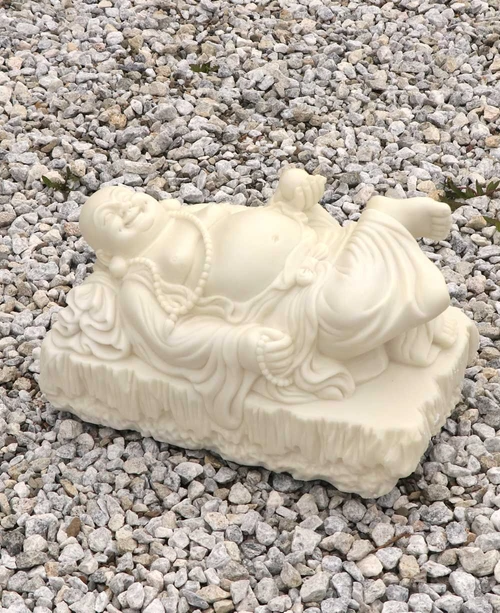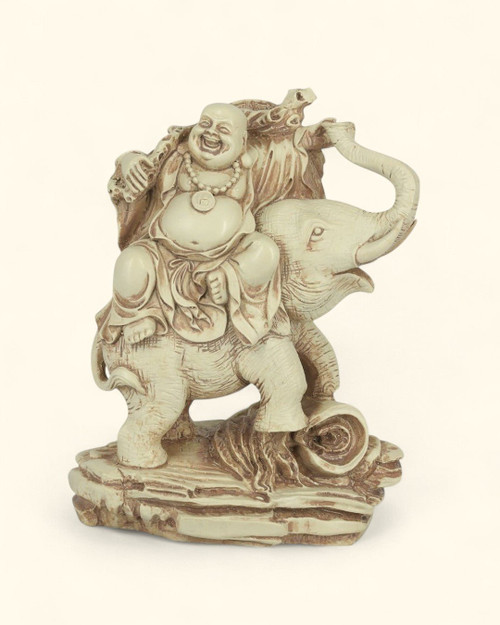


Hotei is the Japanese name given to Budai, the wandering Chinese monk whom the Happy Buddha's image is based on. Depicted with a joyous expression yet with few possessions, the Happy Buddha offers a vision of the inner contentment that we may achieve when we no longer rely on material goods to live a satisfactory life. Made from high quality porcelain.
- Happy Hotei statue
- Made of premium porcelain
- Measures 3 ¼ x 4 ¾ x 3 ¼ inches
- Weighs approximately 7 oz.
Slight variations and imperfections in this item's color, finish, and appearance are artistic qualities that enhance its overall beauty. This item is fragile and must be handled with care.
design: A serenely rotund Hotei figure cast in glossy white porcelain, his robe draped open to reveal a bare belly, prayer beads looped at his neck and wrist, and a wide, joy-filled grin.
size: 3 ¼ x 4 ¾ x 3 ¼ inches; weighs approximately 7 oz.
material: High-quality glazed porcelain.
features: Hand-finished porcelain construction, mala-style beads at neck and wrist, exposed rounded belly, seated cross-legged pose, glossy white glaze
care: Dust gently with a soft, dry cloth and keep away from edges or hard knocks, as porcelain is fragile.
disclaimer: As with any porcelain piece, slight variations in glaze and finish are natural and add to its individual character.
Meaning & Intention
Hotei is the Japanese name for Budai, a wandering Chinese monk whose cheerful, unburdened way of living inspired centuries of art and legend. Carrying almost nothing yet radiating delight, he came to embody a simple teaching: contentment isn't found in what we accumulate, but in how lightly we're able to hold it.
His bare, rounded belly is traditionally read as a symbol of abundance and good fortune, often rubbed for luck, while his open robe suggests nothing hidden and nothing to protect. The strand of beads at his neck and wrist echoes a mala, a quiet nod to prayer and mindful repetition even amid his easy laughter.
Displayed in a home, Hotei's smile works less like decoration and more like a daily cue: a small, recurring invitation to loosen your grip on stress and return to a simpler kind of happiness.
Set on an entry table, a desk, or an altar, this Happy Hotei becomes a small daily checkpoint, a smiling face that catches your eye on the way out the door or during a quiet pause at home, nudging you back toward lightness whenever the day starts to feel heavy.
Essence & Elements
- Ideal For: Anyone who wants a daily, lighthearted reminder to release stress and welcome contentment
- Purpose: Home décor, altar or shrine centerpiece, meditation space accent, gift for good fortune and new beginnings
- Suggested Mantra: Let go, and laugh
- Intention: Joy, Contentment, Abundance, Letting Go
- Chakra Connection: Solar Plexus Chakra
Questions & Guidance
Who is Hotei, the Happy Buddha?
Hotei is the Japanese name for Budai, a wandering Chinese monk known for his joyful nature and few possessions, whose image became a beloved symbol of contentment and good fortune.
What is this statue made of?
It's crafted from high-quality glazed porcelain, giving it a smooth, glossy white finish.
How should I care for a porcelain statue like this?
Simply dust it with a soft, dry cloth and handle it gently, keeping it away from edges or hard surfaces where it could chip.
Where is the best place to display it?
Many people place Hotei near an entryway, on a desk, or on a home altar, anywhere they'll see his smile often throughout the day.
Is the Happy Buddha the same as Siddhartha Gautama, the historical Buddha?
No, they're distinct figures. This joyful, round-bellied form depicts Hotei/Budai, a separate figure from the historical Buddha, often associated with happiness and abundance rather than enlightenment teachings.