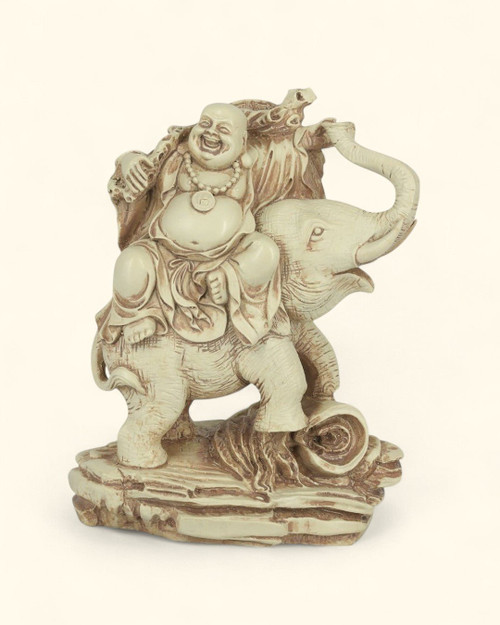


Bring joy and prosperity to your space with this delightful Happy Buddha statue, standing with hands raised joyously in the air. Adorned with symbols for good blessings, this statue exudes happiness and positive energy. Crafted in a stone finish with flowy robes, it is garden-friendly and perfect for both indoor and outdoor settings. The Happy Buddha holds a nugget in one hand and an orb in the other, standing on a money bag to symbolize wealth and abundance.
- Dimensions: about 16" high, 8" wide, 5" deep
- Weight: Approximately 13 lbs
- Material: Polystone
- Suitable for both indoor and outdoor use
- Features symbols for good blessings
- Holds a nugget and an orb, standing on a money bag
design: A joyful Happy Buddha stands with both arms raised overhead, head thrown back in laughter, his ample belly bare beneath flowing robes. He is finished in a soft ivory stone tone with warm antiqued highlights that settle naturally into the carved folds and details.
size: About 16" high x 8" wide x 5" deep.
material: Polystone
features: Hands raised in a gesture of celebration, nugget held in one hand and orb in the other, stands atop a money bag, robe carved with classic key-fret and medallion patterns, stone-finish exterior, suitable for indoor or outdoor display
care: Wipe clean with a soft, dry cloth, and if displayed outdoors, bring the statue in or cover it during freezing temperatures or prolonged heavy rain.
disclaimer: As with any handcrafted stone-finish piece, slight variations in shading and texture are normal and make each statue one of a kind.
Meaning & Intention
Known across Chinese folk tradition as Budai, the Laughing or Happy Buddha, this jovial figure is beloved as a symbol of contentment, good fortune, and abundance. Unlike serene, meditative depictions of the Buddha, Budai is shown mid-celebration — belly bared, face lifted in unrestrained laughter, arms thrown skyward as though he has just received the best news imaginable.
In this pose, his raised hands hold a nugget and an orb, traditional emblems of wealth and completeness, while his feet rest on a bulging money bag carved with auspicious coin motifs. Together these details tell a simple story: prosperity arrives not through striving, but through an open, generous, and light-hearted spirit. His round belly is itself a symbol, representing not excess but the fullness of good fortune and the capacity to hold life's joys and burdens with equal ease.
Many households and businesses welcome a Happy Buddha statue as a quiet daily reminder that abundance and laughter are meant to be shared. Placed near an entryway or a well-used room, he is less a religious icon than a cheerful keeper of good energy — an invitation to greet each day, and each guest, the way he does: arms open, spirit light.
A piece like this earns its place in daily life simply by being seen — on a shelf, a windowsill, or beside the front door, where its uplifted arms and open laughter offer a small, recurring nudge toward gratitude and good humor whenever you pass by.
Essence & Elements
- Ideal For: Anyone welcoming more joy, luck, and abundance into their home or garden
- Purpose: Home decor, garden accent, gift for a housewarming or new venture, altar or shelf display, entryway welcome piece
- Suggested Mantra: Joy invites abundance
- Intention: Joy, Abundance, Gratitude, Good Fortune
Questions & Guidance
Can this Happy Buddha statue be displayed outdoors?
Yes, it's crafted from durable polystone with a stone-style finish, making it suitable for covered outdoor spots like a garden or patio, as well as indoor display.
What are the nugget, orb, and money bag meant to represent?
These are traditional symbols of wealth, completeness, and prosperity, often shown with the Happy Buddha as a wish for abundance and good fortune in the home.
How much does the statue weigh?
It weighs approximately 13 pounds, giving it a solid, stable presence wherever it's placed.
Is this a religious representation of the Buddha?
This figure depicts Budai, a folk figure associated with happiness and abundance in Chinese tradition, distinct from devotional images of Buddha Shakyamuni used in meditation practice.
Where is the best place to display this statue?
Many people place it near an entryway, on a shelf, or in a garden, so its joyful gesture is visible to those coming and going.