
Cairn Sculptures: Stacked Stones as Markers, Meditations, and Décor
Posted by Buddha Groove on May 19th 2026
Long before they became garden ornaments, cairns were how people told each other: someone was here, the path goes this way, this ground is worth remembering. A decorative cairn carries that lineage into the home — a small stack of stones that asks you to slow down enough to notice it.
What a Cairn Actually Means
A cairn is a deliberately stacked pile of stones, built by human hands as a marker. The form is roughly 5,000 years old and shows up across nearly every continent — Scottish hilltops, Inuit inuksuit across the Arctic, Tibetan lhatos at mountain passes, Andean apachetas along high trails, Norse memorial mounds along coastlines.
The shared meaning is quiet and practical: this place matters. A cairn might mark a summit, a grave, a trail junction, a sacred boundary, or simply a moment a traveler wanted to honor. In Himalayan Buddhist practice, adding a stone to a roadside cairn is a small offering — a way of leaving intention on the path for whoever comes next.
That's the inheritance a decorative cairn pulls into a living room or garden bed. It isn't trying to be a sculpture of something else. It is the something else, scaled down: a marker that the spot it sits on is worth pausing for.
The Quiet Logic of Stacked Stones
Stones stack against gravity. That's the whole appeal, and it's also why the form reads as meditative across cultures — to build a real cairn requires patience, weight matching, and a steady hand. A decorative cairn sculpture preserves that visual logic without asking you to balance anything yourself.
A cairn is the rare ornament that means more the longer you've lived with it.
The stones look improbable but feel inevitable. There's a reason cairn-stacking has become a recognizable form of beach meditation in the last two decades — the act demands the same single-pointed attention as breathwork. A sculpted cairn at home is a reminder of that attention, frozen in resin or cast metal, available even on the days you have none.
Artistic Representations Worth Knowing
Decorative cairns split into a few clear families, and the material tells you most of what you need to know about how each one will read in a space.
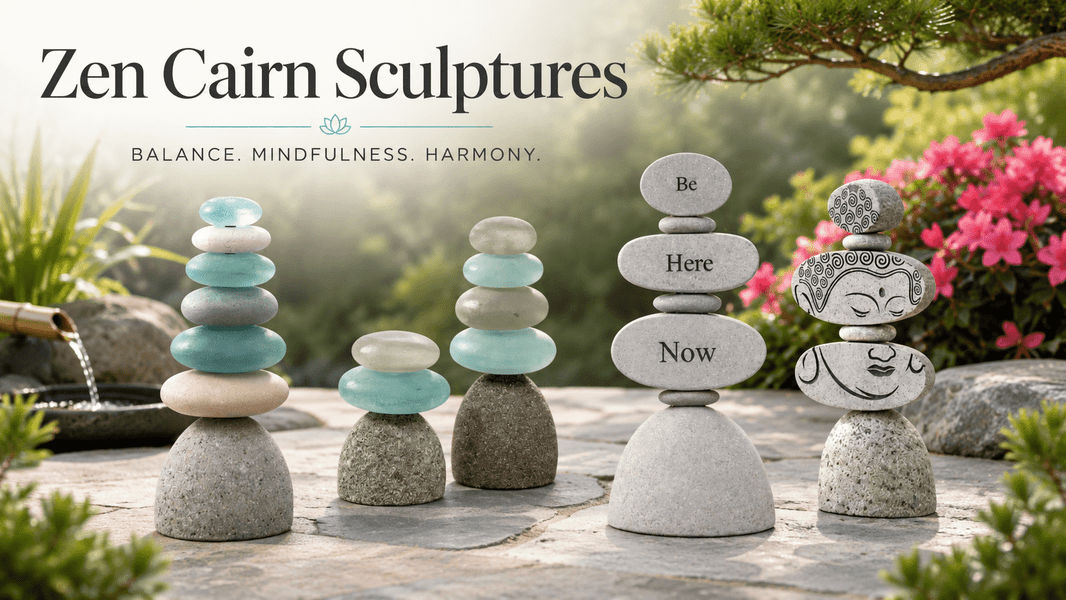
Engraved-stone cairns lean spiritual. A stack carved with the Om symbol — the foundational sound of Hindu and Buddhist practice, often translated as the vibration the universe makes — turns the sculpture into a working mantra you happen to walk past. The Artistic Om Garden Cairn Sculpture is the cleanest example of this approach: weathered-stone finish, the Om carved across a central stone so the symbol sits at eye level when the piece is on a low garden wall or entryway bench.
Buddha-engraved cairns carry the same logic but swap the syllable for a face. Some pieces render the Buddha in low relief on a single stone in the stack; others — like the Artistic Zen Buddha Garden Statue — integrate a seated Buddha into the cairn form itself, so the figure and the stack become one silhouette. These pieces sit well near a meditation cushion, a reading chair, or the entry to a garden path.
Inspirational-text cairns trade iconography for language. A cairn carved with Be Here Now — the title of Ram Dass's 1971 book and arguably the cleanest three-word distillation of contemplative practice in English — does what the engraved Om does, just in a register that reads as accessible rather than devotional. The Be Here Now Inspirational Cairn Garden Statue is the version most people gravitate toward as a gift, because the message lands without requiring shared tradition.
Mixed-material cairns are the contemporary branch of the family. The Glass and Stone Cairn Garden Statue — frosted sea-glass discs alternating with weathered river rock — is the form most people don't expect to love until they see it lit from behind by afternoon sun. The glass catches light the way water catches light; the stone grounds it. The visual rhythm is the same as a traditional cairn, but the piece reads as sculpture rather than artifact.
Miniature cairns are the desk-and-shelf scale. Three to seven inches tall, often cast in resin or bronze, sometimes with a tiny figure — a meditating monk, a wandering pilgrim — perched at the base. They function less as garden markers and more as object-companions: the kind of thing you reach over and touch while you're on a long phone call.
Materials and What They Do
A short field guide to what the stack is actually made of:
- Cast stone (concrete-and-resin composite): outdoor-safe, weight feels like real stone, weathers gracefully — picks up moss and patina over years.
- Pure resin: lighter, frost-sensitive, best for covered porches or interiors. Holds fine engraving detail better than cast stone.
- Bronze and cast iron: the heirloom tier. Develops a verdigris or rust patina that most people end up preferring to the original finish.
- Sea glass and rock combinations: the glass is real (tumbled, frosted), the rocks are usually river stone or basalt. The interaction with light is the whole point — these belong somewhere a sunbeam will find them at least once a day.
- Hand-carved soapstone or sandstone: rarer, usually small-scale, often imported from Rajasthan or the Himalayan foothills. The carving lines stay soft because the stone itself is soft.
Where to Put Them
A cairn wants a threshold. Not the dead center of a coffee table — the edge of a space, the place where one zone becomes another. A few placements that consistently work:
- The entry path or front step. Original cairns marked the way. A sculptural one at the door does the same job for guests.
- The base of a garden bed, especially where a path forks or where you want the eye to pause before scanning the planting.
- Beside a meditation cushion, altar, or reading chair — the indoor version of the trail marker, indicating this is where I sit.
- On a shelf with negative space around it. A cairn surrounded by clutter disappears. A cairn with six inches of bare shelf on each side becomes the room's quiet center.
- In a window where light moves across it during the day — particularly for glass-and-stone pieces, which essentially become small sundials.
The one placement to avoid: high shelves where the piece is read from below. Cairns are designed to be looked at, not looked up at. Eye level or lower is almost always right.
What a Cairn Can Remind You Of
Different traditions have leaned on the stacked-stone form for different reasons, but the through-lines are worth naming:
- That this moment is worth marking. The original function, intact.
- That patience builds things gravity wouldn't. The stack itself is the argument.
- That you are on a path someone has walked before. A cairn was placed by a person; you are passing the place they paused.
- That presence is enough. Be Here Now, Om, a Buddha's lowered gaze — different vocabularies for the same instruction.
A good decorative cairn doesn't insist on any of this. It sits where you placed it and waits. The reminders surface on their own, on the mornings you need them.
If you're choosing one, start with the question of where it will live — outdoor or indoor, sunlit or shaded, traffic path or quiet corner — and let the material follow from that. The meaning is already built in.